0. Quick Overview
ISO 16890 is the internationally valid test and classification standard for air filters used in general ventilation and air conditioning (HVAC). The standard has been in force since December 2016 and replaced EN 779 as the mandatory classification basis on 30 June 2018. The defining innovation is that filter efficiency is now expressed in relation to the ambient air quality particulate matter fractions PM1, PM2.5 and PM10 as defined by the WHO and environmental agencies – rather than against a single synthetic test particle size. The definition of PM fractions traces back to the US EPA's National Ambient Air Quality Standards introduced in 1987. PM stands for Particulate Matter (aerosol / suspended particles).
The four filter class groups ISO ePM1, ISO ePM2.5, ISO ePM10 and ISO Coarse have replaced the former classes G1 through F9. Operators and planners of HVAC systems – in hospitals, airports, exhibition halls, swimming pools, schools or shopping centres – can use the new classification system to select appropriate filter solutions far more intuitively than was possible under EN 779:2012. The new test method determines separation efficiency across all particle sizes present in outdoor air between 0.3 and 10 µm, rather than exclusively at 0.4 µm as before. This aligns the standard far more closely with real-world operating conditions. Efficiency of fine-dust filters is determined without prior dust loading, eliminating the problematic dependence of filter efficiency on a synthetic test dust and making the declared performance value significantly more reliable than efficiency figures under EN 779.
When selecting filters with respect to desired indoor air quality, the new group structure is considerably more user-friendly. Four filter groups require declaration of the percentage separation efficiency within the corresponding particle spectrum. A filter classified as ISO ePM1 75% has a minimum separation efficiency (e) of 75% for particles ≤ 1 µm. Filters whose separation performance is below 50% for PM10 are assigned to the coarse dust class ISO Coarse.
| Class | Efficiency range | Example particles / fine dust |
|---|---|---|
| ISO ePM1 | ePM1,min ≥ 50% | Viruses, bacteria, nanoparticles, soot (from fossil fuels), sea salt, oil mist |
| ISO ePM2.5 | ePM2.5,min ≥ 50% | Bacteria, fungal & mould spores, pollen, toner dust |
| ISO ePM10 | ePM10 ≥ 50% | Pollen, mineral dust, agricultural dusts |
| ISO Coarse | ePM10 < 50% | Sand, lint, airborne seeds, hair, etc. |
Particle size comparison:
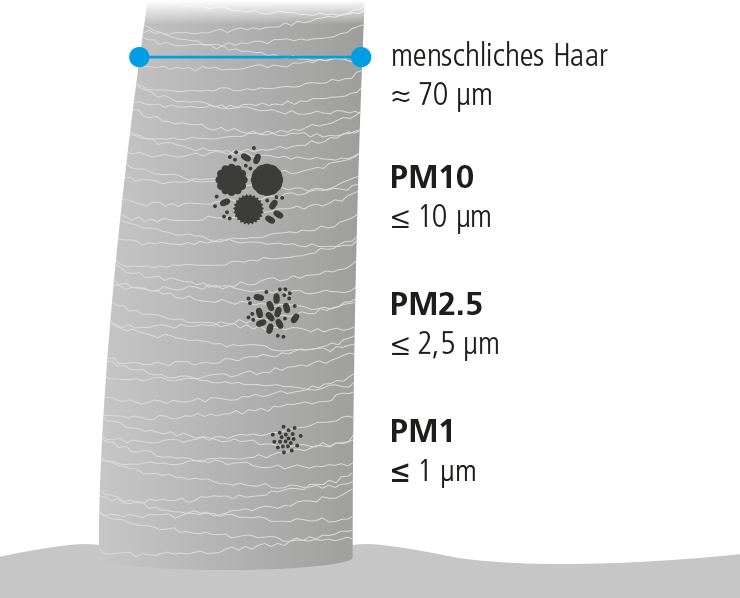
1 µm = 0.001 mm
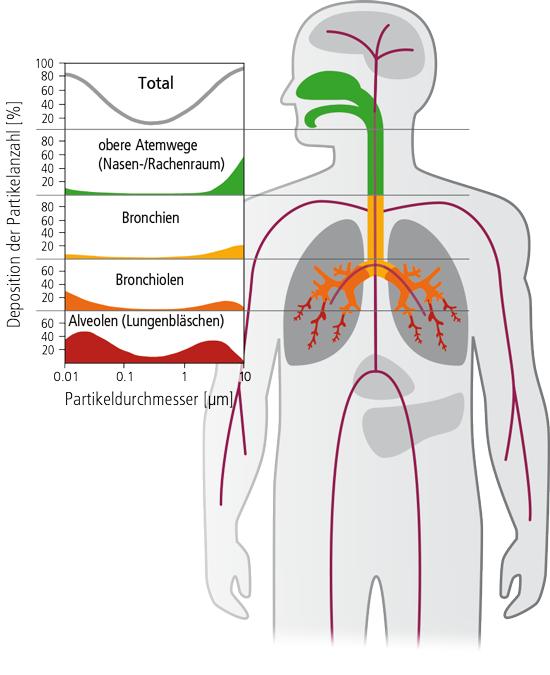
The human body takes up a large number of particles and dusts through the air we breathe. Fine particle fractions in particular constitute the majority of these particles by count and can pass through the alveoli into the bloodstream and organs. Filters within the scope of ISO 16890 reduce particle concentrations in the range >0.3 µm by up to >90%. To achieve higher separation efficiencies of up to >99.999995% for sub-micron particles, filters within the scope of EN 1822 / ISO 29463 are required.
Deposition of particles in the respiratory tract:
Timeline for the introduction of ISO 16890:
| Year | Milestone |
|---|---|
| 2016 | ISO 16890 published by ISO in December 2016 |
| 2017–2018 | Transition period; EN 779:2012 runs out. From May 2018 ISO 16890 is required for product marketing; from 30 June 2018 EN 779 is fully withdrawn and ISO 16890 is mandatory. |
| 2023 | Parts 2 and 4 of ISO 16890 updated (minor technical revisions). |
1. Introduction
Regular measurement of ambient fine dust concentrations began worldwide well before the 1990s. National environment agencies, the Federal Environment Agency (Germany) and the WHO now publish local air quality data for the particulate matter fractions PM1, PM2.5 and PM10 (hereinafter PMx) on a regular basis. However, these measurement values could not be linked meaningfully to the then-valid filter classification standard EN 779. Under EN 779, the efficiency of coarse dust filters (group G) is determined gravimetrically using a defined synthetic test dust (ASHRAE). For fine dust filters (groups M and F), the efficiency increase under dust loading at particle size 0.4 µm (DEHS) is additionally measured and averaged, with a minimum efficiency criterion applied to group F filters. The motivation for introducing ISO 16890 was precisely to establish a direct relationship between filter performance and measured ambient air quality values. The key aspects of the standard are described below.
2. Structure of ISO 16890 and Filter Classification
ISO 16890 "Air filters for general ventilation" consists of four parts:
ISO 16890-1: Technical specifications, requirements and efficiency classification system based upon Particulate Matter (PM)
This part covers the efficiency classification system for air filters for general ventilation based on particulate matter (PM). It also provides an overview of the test procedures and the general requirements for filter evaluation and marking, and defines the documentation of test results.ISO 16890-2: Measurement of fractional efficiency and air flow resistance
This part specifies aerosol generation, test equipment and test methods used to determine the fractional separation efficiency and air flow resistance of an air filter for general ventilation.ISO 16890-3: Determination of the arrestance and the air flow resistance versus the mass of test dust captured
This part describes the procedure for determining the gravimetric efficiency and air flow resistance for a given air cleaning device. After determining initial efficiency and separation efficiency in the conditioned state, the filter element is loaded with synthetic test dust until the final pressure differential is reached. To determine dust holding capacity, the pressure drop curve relative to dust loading is recorded during the test.ISO 16890-4: Conditioning method to determine the minimum fractional efficiency
This part describes a procedure for the artificial ageing (electrostatic discharge) of filters to determine the minimum fractional separation efficiency of both electrostatically charged and uncharged filter media. The conditioning procedure applies the filter element – as a complete, assembled unit – to an atmosphere saturated with isopropanol vapour (IPA) for a defined period of four hours. This part describes exclusively the test apparatus and the equipment required for conditioning. The method is applicable regardless of the media type used in the filter (e.g. glass fibre or synthetic).
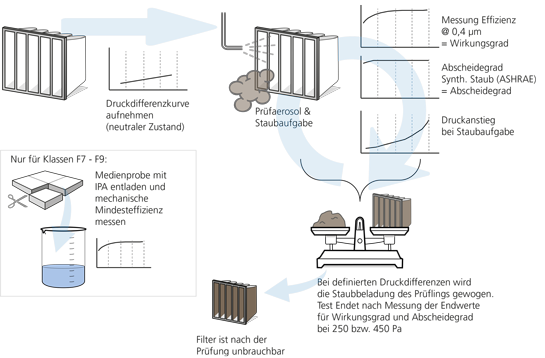
The still-referenced predecessor standard EN 779:2012 classified air filters according to their separation efficiency against synthetic test dust (ASHRAE) for coarse dust filters in class group G. For fine dust filters in groups M and F, the efficiency increase under dust loading at particle size 0.4 µm (DEHS) was additionally measured and averaged. A minimum efficiency criterion applied to group F filters. For the determination of this minimum efficiency, the potential electrostatic charge was discharged on a media sample using an IPA bath, and the purely mechanical efficiency in the initial state was then measured on a flat sheet specimen. Crucially, it was therefore only a media sample – not the complete filter element – that was tested for minimum separation efficiency under EN 779.
Under ISO 16890, the test procedure and measurement process are comparable to EN 779 in principle. However, classification is no longer based on efficiency against a single particle size (0.4 µm) but against the PMx fine dust spectra. For classification purposes, both the particle size distribution in raw and clean gas and the fractional separation efficiencies (efficiency value E) according to ISO 16890 are applied.
The ISO 16890 terminology includes:
| Metric | Description |
|---|---|
| di | Lower boundary of the particle diameter in size class i, in µm |
| di+1 | Upper boundary of the particle diameter in size class i, in µm |
dl |
Geometric mean of the particle diameters in size class i, in µm |
| Δdi | Width of size class i, in µm |
| Ei | Initial efficiency of the untreated filter element for size class i, in % |
| ED,i | Initial efficiency of the IPA-discharged filter for size class i, in % |
| EA,i | Arithmetic mean of Ei and ED,i |
ISO 16890 groups filters according to their efficiency against the PMx particle spectra (see classification table below). The spectra include all measured particles whose size is less than or equal to 1, 2.5, or 10 µm respectively. The smallest measured particle fraction is 0.3 µm.
Filter classification according to ISO 16890
| Group | Classification criteria | Classification value |
||||
|---|---|---|---|---|---|---|
| Emin (ePM1) |
E (ePM1) |
Emin (ePM2.5) |
E (ePM2.5) |
E (ePM10) |
||
| ISO Coarse | – | – | – | – | <50% | Overall efficiency |
| ISO ePM10 | – | – | – | – | ≥50% | E(ePM10) |
| ISO ePM2.5 | – | – | ≥50% | ≥50% | – | E(ePM2.5) |
| ISO ePM1 | ≥50% | ≥50% | – | – | – | E(ePM1) |
The classification values E(ePMx) are derived from averaged efficiencies. These result from the individual values EA,i and Emin(ePMx). Emin is measured on the electrostatically discharged filter element (using isopropanol vapour atmosphere).
For the determination of Emin(ePM1) and E(ePM1), all size classes from 0.3 µm up to and including 1 µm are taken into account. Correspondingly, the spectra for PM2.5 and PM10 cover 0.3–2.5 µm and 0.3–10 µm respectively. Only the performance data of the unloaded filter medium are considered for all measured values in the test record. The ISO 16890 classification model therefore – in contrast to EN 779 – states and evaluates initial values only. Under EN 779, the efficiency of filters in groups M and F was stated as an average over the dust loading cycle up to a filter resistance of 450 Pa at rated airflow. ISO 16890 accordingly provides no information on efficiency behaviour under dust loading.
All efficiencies listed in the classification table are stated in the test certificates to ISO 16890 with their measured values E(ePMx), rounded to the nearest pentad (multiple of 5%). The measured values are rounded down, and the filter class is determined by the appropriate assignment.
Classification examples for G4, F7 and F9 filters:
| EN 779 filter class (example) | G4 | F7 | F9 | |
|---|---|---|---|---|
| Emin(ePM1) | [%] | – | 55 | 87 |
| E(ePM1) | [%] | – | 63 | 87 |
| Emin(PM2.5) | [%] | 1 | 67 | 90 |
| E(PM2.5) | [%] | 1 | 73 | 90 |
| E(PM10) | [%] | 33 | 91 | 96 |
| A(Coarse) | [%] | 82 | – | – |
| Filter efficiencies | ISO Coarse 80% |
ISO ePM10 90% ISO ePM2.5 70% ISO ePM1 60% |
ISO ePM10 >95% ISO ePM2.5 90% ISO ePM1 85% |
|
| Classification per ISO 16890 | ISO Coarse 80% | ISO ePM1 60% | ISO ePM1 85% | |
The unambiguous classification of filters within the scope of the standard is clearly determined by the metrics in the test certificate. The arithmetic mean of the efficiency of the test specimen in the as-delivered state and in the electrostatically discharged state is calculated and rounded down to the nearest pentad.
The EN 779 F7 filter in the example meets the minimum requirements of class ISO ePM1 and is classified at 60% (E(ePM1) = 63%, rounded down to the nearest pentad = 60%). The manufacturer may also choose the higher value for ISO ePM2.5 as the leading performance criterion. The F9 filter shows an efficiency against PM1 of >50% and is therefore classified under ISO ePM1. The G4 filter with an ePM10 value of 33% (below 50%) falls into the ISO Coarse class, classified at ISO Coarse 80%.
3. New Test Conditions
Under EN 779, efficiency and dust holding capacity were determined using ASHRAE 52.2 test dust. This dust consists of 72% ISO 12103-1 A2 Fine Test Dust, 23% carbon black and 5% ground cotton fibres. This test dust has been criticised because its specific weight – despite a standardised composition – can vary considerably depending on the source, potentially causing measurement results for dust holding capacity to vary or even be deliberately influenced.
The test aerosol DEHS used in EN 779 is excellent for measurements in the sub-micron range. However, it does not allow sufficiently high particle concentrations to be generated for meaningful efficiency measurements at particle sizes in the micrometre range. EN 779:2012 provided for electrostatic discharge to determine the purely mechanical filter efficiency as a minimum performance criterion (minimum efficiency M.E. against 0.4 µm) for group F filters. However, under EN 779:2012 this discharge was carried out on a filter media sample by immersion in an isopropanol bath, followed by a drying phase, and measured on a flat sheet specimen. It was therefore only a media sample – not the complete filter element – that was tested for efficiency in the discharged state.
Under ISO 16890, A2 Fine Test Dust (per ISO 12103) is specified for the gravimetric efficiency determination. This dust consists of >97% silicon oxide (quartz) with other oxides. Its specific weight is considerably higher than the problematic ASHRAE dust used under EN 779, which is no longer used in the new standard. Efficiency against particles is measured up to 1 µm using DEHS aerosol. For the measurement ranges PM2.5 and PM10, KCl aerosol is additionally used, ensuring that sufficiently high particle concentrations are available in the measurement ranges for particles >1 µm.
In contrast to EN 779, the electrostatic discharge under ISO 16890 is clearly defined and requires the complete filter element to be discharged. This is no longer carried out by immersion bath but by exposing the assembled filter element for four hours to a chamber atmosphere saturated with isopropanol vapour. This neutralises the electrostatic charge throughout the filter medium. The complete test therefore relates to a discharged filter element – not merely to a media sample for the minimum efficiency determination as under EN 779.
The test procedures can be illustrated schematically as follows:
The EN 779:2012 procedure:
In contrast, the ISO 16890 procedure:
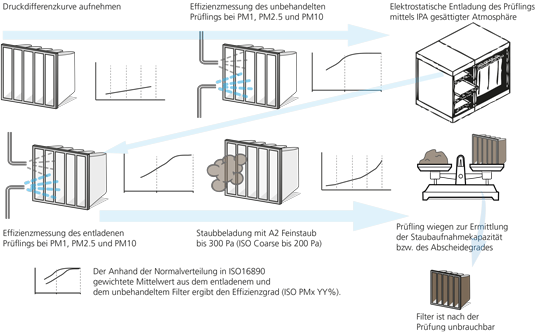
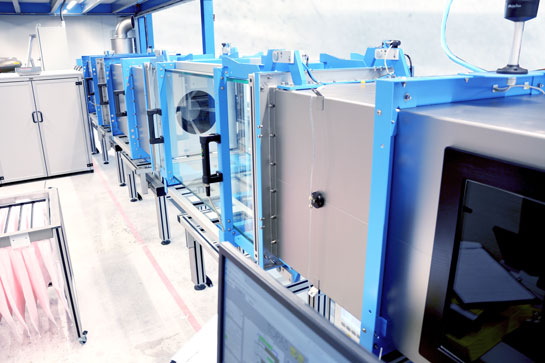
Photo: ISO 16890 & EN 779 test laboratory at HS-Luftfilterbau GmbH
4. Consequences of the Transition
The introduction of ISO 16890 has triggered amendments to a number of related standards and guidelines. This applies, for example, to VDI 6022, which specifies filter classes for HVAC systems to maintain hygienic conditions. Equally affected is EN 16798-3 (formerly EN 13779), which governs the design of ventilation systems for non-residential buildings and recommends filter classes depending on outdoor air quality (ODA categories) and the target indoor air quality (IDA categories). The much greater range of classification options under ISO 16890 has required substantial revision of these related documents.
A complete revision of energy classification models (such as Eurovent 4/21) was also necessary. The energy classification has become considerably more complex due to the more differentiated filter classes. The change in test dust also affects service life assessments.
5. Guidance on EN 779 Equivalences
A simple one-to-one "translation" of ISO 16890 classes to EN 779 classes is not possible given the fundamentally different test and evaluation methods. No standardised conversion table exists, nor can one be assumed given the many layers of difference between the two standards.
Following the revision of VDI 6022-1 (January 2018), the following filter classes are recommended in line with EN 16798-3 for HVAC systems:
| Outdoor air quality (per VDI 6022, Sheet 3a) |
Supply air quality SUP 1 (very high) |
Supply air quality SUP 2 (high) |
Supply air quality SUP 3 (medium) |
|---|---|---|---|
| ODA 1 (clean) | ISO ePM10 50% + ISO ePM1 50% |
ISO ePM1 50% | ISO ePM1 50% |
| ODA 2 (polluted) | ISO ePM2.5 65% + ISO ePM1 50% |
ISO ePM10 50% + ISO ePM1 50% |
ISO ePM10 50% + ISO ePM1 50% |
| ODA 3 (heavily polluted) | ISO ePM1 50% + ISO ePM1 80% |
ISO ePM2.5 65% + ISO ePM1 50% |
ISO ePM2.5 65% + ISO ePM1 50% |
For HVAC systems in single-stage operation or in the second filter stage, an ISO ePM1 filter is therefore generally to be provided as standard.
Based on a comparison of test data from various filter types from multiple manufacturers, the following statistical overview indicates the likely range of EN 779:2012 filter performance under ISO 16890 test conditions. This statistical assessment is based on more than 80 comparative measurements:
| EN 779:2012 | ePM1 | ePM2.5 | ePM10 |
|---|---|---|---|
| M5 | 5% – 35% | 10% – 45% | 40% – 70% |
| M6 | 10% – 40% | 20% – 50% | 60% – 80% |
| F7 | 40% – 65% | 65% – 75% | 80% – 90% |
| F8 | 65% – 90% | 75% – 95% | 90% – >95% |
| F9 | 80% – 90% | 85% – 95% | 90% – >95% |
This is not a universally applicable conversion table but an orientation guide for estimating performance ranges. It does not constitute a normative translation.
HS-AirSynErgy: Maximum Efficiency – Glass Fibre-Free
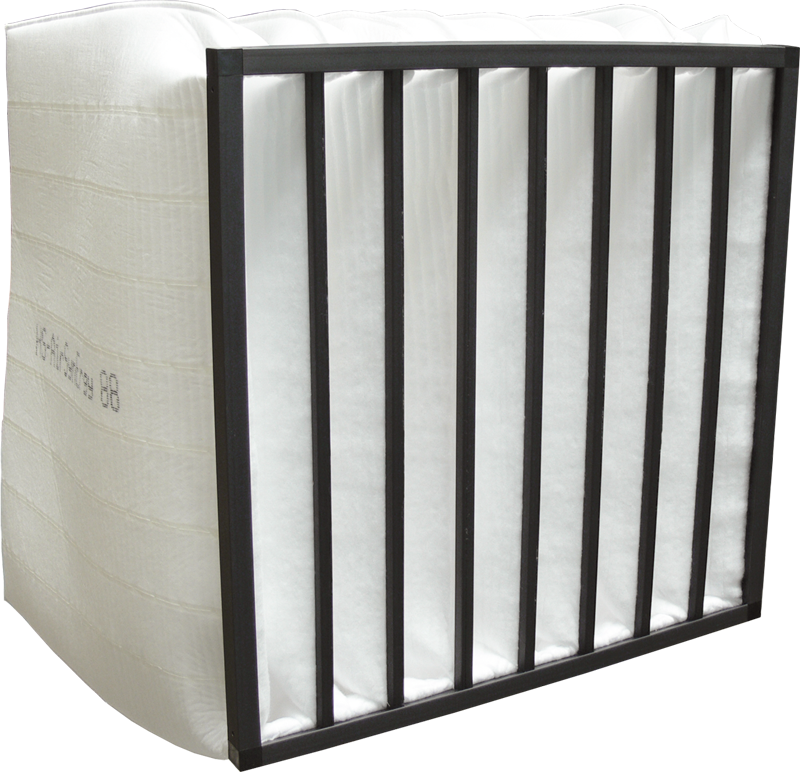
HS-AirSynErgy pocket filters feature the most advanced synthetic filter media available. Benefit from the best possible performance that pocket filters can offer – without releasing fibres as glass fibre pocket filters do.
HS-AirSynErgy pocket filters meet the latest energy standards and are therefore ideal for ventilation systems under the Ecodesign Directive – at a performance up to ISO ePM1 85%!
HS-Luftfilterbau GmbH production processes are certified to ISO 14001 Environmental Management and ISO 9001 Quality Management.
- Interactive Air Quality Map – Europe (EEA)
- WHO – Ambient Air Quality & Health
- ISO 16890 at ISO.ORG
- ISO TC 142 – Cleaning Equipment for Air
- Matching air filters at luftfilterbau.de
- ISO 29463 – HEPA & ULPA Filters
Further Information
HS-Mikro Pak: Optimised Airflow Performance
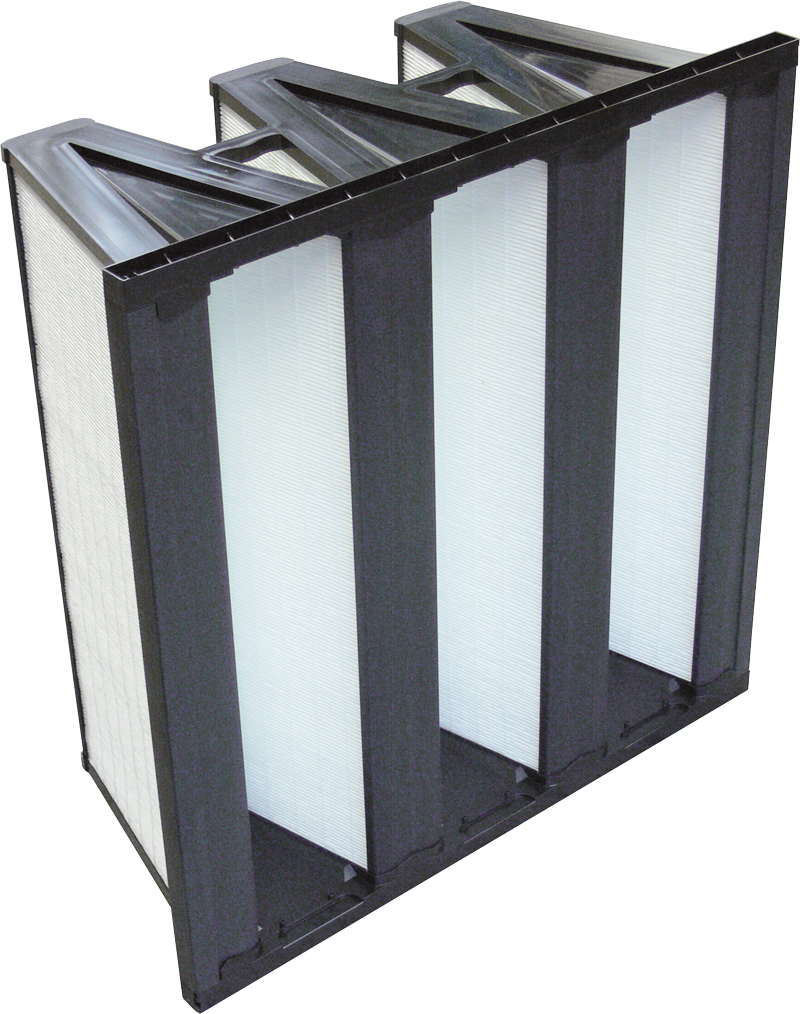
HS-Mikro Pak compact filters offer superior airflow characteristics compared to many other compact filters. The intelligent design minimises constructive flow resistance. Low installation depth combined with high volumetric flow rates open up a wide range of applications in energy-optimised HVAC systems and combustion air intake for turbomachinery (e.g. gas turbines).
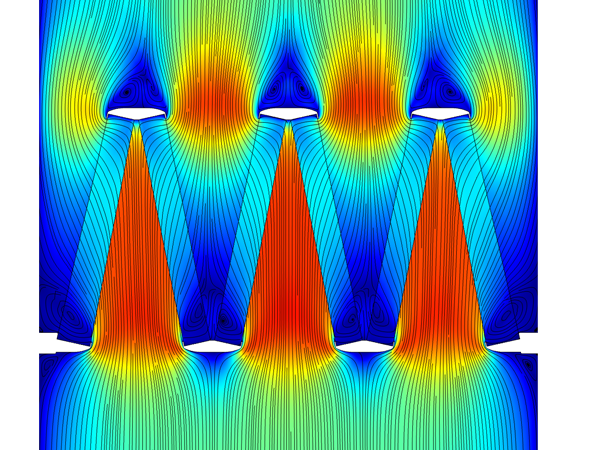
Excellent flow profile, best filter media only – that's how good compact filters reach class ISO ePM1 95%!
HS-Luftfilterbau GmbH
Leading manufacturer of air filters for HVAC, ventilation and cleanroom technology. We produce over 80,000 different filter types and filter products for a wide range of applications, including:
- Filter media rolls & pads
- Panel filter cells (Z-Line)
- Pocket / bag filters
- Compact filters
- HEPA / ULPA filters
- Filter systems & housings